
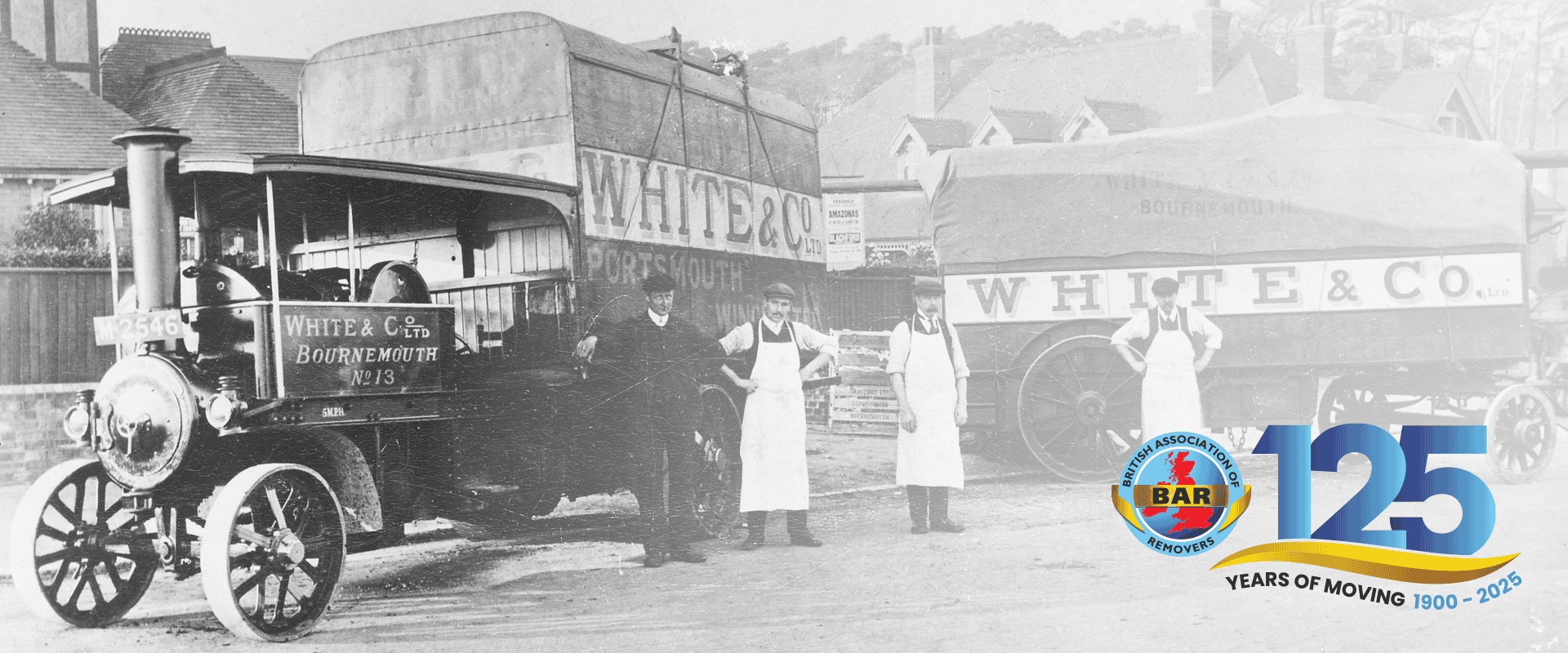
The history of removals in Britain is one that embraces the transportation and storage of a wide variety of goods, carried out by an even wider variety of people!
Whether by hand, horse & cart, or mechanised means, and variously via canal, rail, road, sea and air, some companies have always carried out the removals and storage of people’s goods. However, many of the long-established removal companies of today (and their predecessors) were borne out of other industries. These industries include furniture-makers; general carriers and hauliers; coal and oil merchants; and even funeral directors – with the specialism that we see today mostly coming later.
Setting the standard for removals
Founded in 1900, the BAR is the UK’s oldest and primary Trade Association for the removal industry, having operated for 125 years. As an independent trade association for the industry the British Association of Removers (BAR) sets the standard for professional removals in the UK. All Members must maintain strict standards covering everything from how they operate to the quality of their removal vehicles, ensuring they provide a quality service to their customers at every stage of the move.
The BAR was formed in 1972 by the amalgamation of the British Association of Overseas Removers (BAOFR) and the National Association of Furniture Warehousemen and Removers Ltd (NAFWR), the latter a revised name of the originalFurniture Warehousemen and Removers’ Association (FWRA).
How it all began
In most cases trade associations are formed when a group of businesses in a particular industry set aside their competing interests and instead look to achieve common goals, shared ambitions, and industry gains through mutual collaboration. And this is exactly how the FWRA came into being 125 years ago, though it is interesting to note that some of the challenges of yesteryear mirror those which the industry faces today.
The following are excerpts taken from an article published in the Association’s trade publication Removals and Storage in January 1930, written by Victor Brown J.P, First the Honorary Secretary and Treasurer of the time.
‘Early in the year 1900, Mr L. Byng Hall, who was then the Managing Director of the Pall Mall Deposit & Forwarding Co. Ltd., suggested to me that it would be a good idea if an Association were formed in the Removal trade, similar to the American and German Associations. I was then asked to invite the leading firms in the country to attend a meeting. The outcome of this was that it was decided to have a general meeting of the members in town and country to discuss matters of interest and decide as to the advisability of forming an Association.
With this object a meeting was held on May 3rd, 1900, which was very representative of the trade.
Mr Hall then asked Mr F. Tapner (Messrs. W. Whiteley Ltd.) to address the meeting. Customers were more exacting (he said) and less honourable as competition grew, and now made the most trivial claims which were never thought of years ago. He considered that the Association, if formed, should at once discuss the desirability of formulating a standard liability, which could be adopted by the trade generally.
The Insurance Companies were also very exacting. Labour was another factor which would have to be reckoned with.
A discussion followed in which Messrs. H. Day (Harrods Ltd), J.A. Evans (C. & G. Ayres), Wm. Boote (Wm. Boote & Son), W.H. Bunscombe (C. Taylor & Sons), – Hibbard, Peter Bendall (Barnby Bendall & Co.), Ben Purser, W.H. Payne (Payne & Birdseye) took part, the last gentleman suggesting an estimate form be made out by the Executive Committee for the use of Association and submitted to the members before adopting. This suggestion met with warm approval from the meeting.
It was proposed and seconded and agreed to that an Association be formed and called The Furniture Warehousemen and Removers’ Association. This resolution being put to the Meeting was carried out unanimously. It was agreed that the Annual Meeting should be held about the middle of May each year.
May 3rd, 1900, was an important day in the removal and warehousing trade, when the Association was formed to be of general use to the members of the trade, and not, as a good many think, the Trade for the Association. I sometimes wonder whether this is really understood, and if some of the members are not more keen to take more out of the Association than they put into it.’


